What a wild experience it is to see a project that has haunted me for years finally come together. In some ways, it feels like it happened so suddenly, but then again I also know exactly how many hours I’ve spent staring at my laptop over the last few months.
On the night when I submitted my draft to my committee, I took a screenshot of my screen time to commemorate the moment:
The transformation of this project took me completely by surprise, and I’m leaving my doctoral experience as a changed person — in ways that matter far more to me than simply adding a few extra initials behind my name.
My words, stories, and takeaways are now in the hands of my committee members. Soon, they’ll be sent off to the examiners who’ve agreed to review my work, and then comes my defence: March 24th. After that, well, I may finally be done with school (fingers crossed).
It still hasn’t quite set in that I don’t have a draft of Chapter 4, 5, or 6 hanging over my head anymore.
There’s a part of me that still feels such joy in what this inductive journey has unexpectedly taught me, along with a real sense of humility in recognizing how different my original research intentions were from where I eventually landed.
the drafted TOC
Since this newsletter has always been a place where I think aloud, it feels right to let it hold a few of the words that brought my dissertation to a close.
I’m so grateful that so much of the wisdom I’ve come to through this narrative inquiry did not come from a theory book, but from the native prairie landscape that I love and return to again + again.
Here are a few excerpts from the final chapter of my dissertation:
In the short, waning days of December 2025, I sat in my usual writing spot in the living room, settled in the middle of the couch with my laptop flipped open, a cup of hot tea steaming by my side. As I paused to scrutinize a sentence I had just typed, my teenaged daughter suddenly bounced into the room, interrupting the flow of my writing process yet again. For the past several years, she has watched her mama take up space in this exact same spot, as I would steal small pockets of time to work on my dissertation while also navigating a full-time position at the University and parenting on my own. By this point, she also knew that the writing of my dissertation was nearly finished. “Are you finally going to take down the post-its?” she asked me, her tone sweet but impatient.
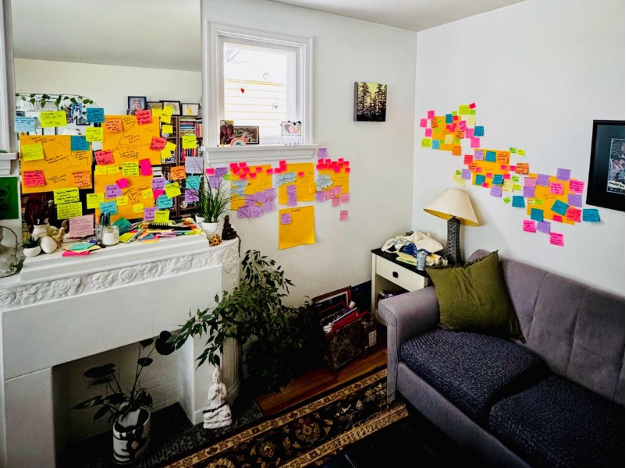
Throughout the last few years of my doctoral journey, both Emma and I have watched the walls of our living room slowly transform into a kind of evolving whiteboard, a space filled with multiplying post-it notes, tacked up and spreading across our walls, tracking any ideas or insights that emerged as my research continued to change and expand in its scope. What began as a quick study technique used during my comprehensive exams gradually became the primary way I organized and made sense of the research as it unfolded in this dissertation. These colourful slips of paper have been my constant companion as I found my way forward as a new researcher, supporting my ongoing efforts to search and “re-search ” as I reflected on what it means to live and work authentically as an educator in a culture shaped by the values of the performance model.
Figure 28
Photo of my living room walls, January 2026
Over time, these small, floating squares of scribbled insights have come to mark how I enter the closing moments of this final chapter. I feel more grounded as I write my dissertation’s conclusion, knowing that these ideas, quotes, and reminders of others gather around me, both in their physical presence, and in the ways their voices continue to offer me support as I sit with what this research, shaped alongside my co-participants, has set in motion.
I don’t know how I’ll feel about my living room space when I finally take down all these post-it notes.
Taking root
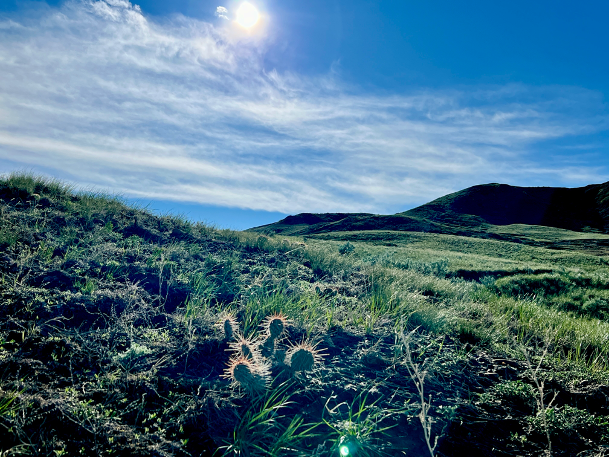
Earlier in Chapter 2, I wrote at length about the personal connection I feel to the native prairie landscape of Grasslands National Park, a land defined by paradox and contrast, where stretches of dry, abandoned stillness exist alongside pockets of fertile life. As stark as the prairie can be in certain places, with cracked riverbanks and rocky pathways dotted with sharp cacti, there are also areas where entire fields of plant life seem to take over, transforming what once appeared barren into a sea of rolling green. My love for this land has taught me many lessons about what it means not only to live, but to live well, in demanding environments.
Figure 29
The sun shines down on the native prairie landscape.
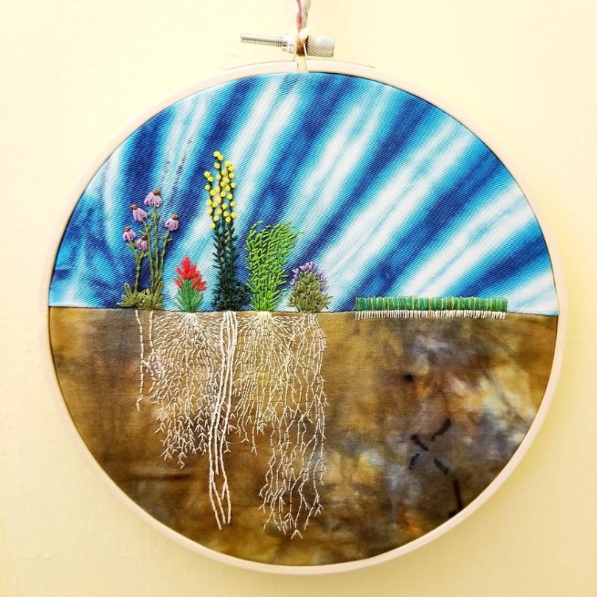
Whenever I make my way back to this land, I carry a sense of curiosity and appreciation for the many forms of life I encounter along its trails and pathways, aware that what is visible to my eye represents only a small portion of what is to be found, rooted below. I have since learned that some native prairie plants extend their root systems as far as 15 feet beneath the surface, with close to two-thirds of all plant life in grassland environments found underground (The Plant Native, 2025). Learning that most prairie flora exists beneath the surface of the landscape only increased my affection for this place, a land that I have long felt drawn to, in ways I still find difficult to explain.
A few years ago, I came across a piece of embroidery art that echoed this same insight, capturing the quiet, grounding power found in having deep roots. I have never forgotten the impact of seeing this piece appear on my social media timeline for the first time. The stitched artwork shown in Figure 30 illustrates the contrast between the extensive root systems found in native prairie grasses and those of shallower, more conventional lawn grasses. Placed side by side, the contrast between the root systems is stark and memorable:
Figure 30
Root systems of native prairie plants compared to traditional lawn grasses
Note. Work by Melora Bales from https://www.facebook.com/share/p/172o7JPRSW/ Used with permission.
Beyond appreciating its visual appeal and artistry, the juxtaposition in the artwork invited me to reconsider how qualities such as strength and beauty come to be valued in settings where attention remains fixed on what can be immediately seen. As I sat with the image, I found myself returning to questions that have followed me throughout this dissertation, particularly those concerning the actions and identities academia tends to cultivate and reward. When I first began this inquiry, I could not yet name the questions that lingered in the background of my working life, despite the personal and professional costs of continually working to answer them.
Some of these unspoken questions are closely tied to matters of appearance, to the surface-level impressions of academic work and the identities educators often feel pressure to project: Am I doing enough? Do I really deserve my place here? How long can this pace be sustained? Other questions may be less visible, but are no less powerful in their echo, centring on issues of belonging and safety: What is expected of someone in this position? What happens if those expectations are not met? Who is watching, and what power do they hold? Is it safe to say this out loud?
It was while sitting with these questions that the landscape metaphor began to take on greater meaning. As I spent more time thinking about landscapes dominated by conventional lawn grasses, plants that spread quickly and often crowd out other forms of growth, the metaphor began to inform an interpretation of the performance model. Typical lawns are uniform and visually standardized across neighbourhoods, become resource-intensive in their demands for water and care, and are maintained largely for their appearance. A native prairie landscape, by contrast, is rugged, uneven, and deeply rooted, and is often underestimated for its beauty. Viewed side by side, these landscapes illustrate a parallel contrast found in academic life: between educator identities shaped by surface-level demands aligned with the performance model, and those grounded more securely in an educator’s values and purpose.
At the end of this first step in researching the impacts of the performance model, the elements that shape academic landscapes, both at USask and more broadly, come into clearer view. Rather than looking outward for ways to endure what can be a harsh academic landscape, the inquiry’s findings highlight the importance of turning inward, attending to the inner landscapes that shape educator identity. It is in these inner landscapes that educators learn how to live with forces beyond their control, by placing greater trust in the roots that ground their values and sense of purpose as educators.
I’m so proud of this work, and I am a different person on the academic landscape as a result.
Congratulations. Now that it’s done reward yourself at the used book sale at Market Mall Friday, Saturday and Sunday. Chance to finally read for pleasure instead of work.








Yayyyyyyy!!!!!
Congratulations. Now that it’s done reward yourself at the used book sale at Market Mall Friday, Saturday and Sunday. Chance to finally read for pleasure instead of work.